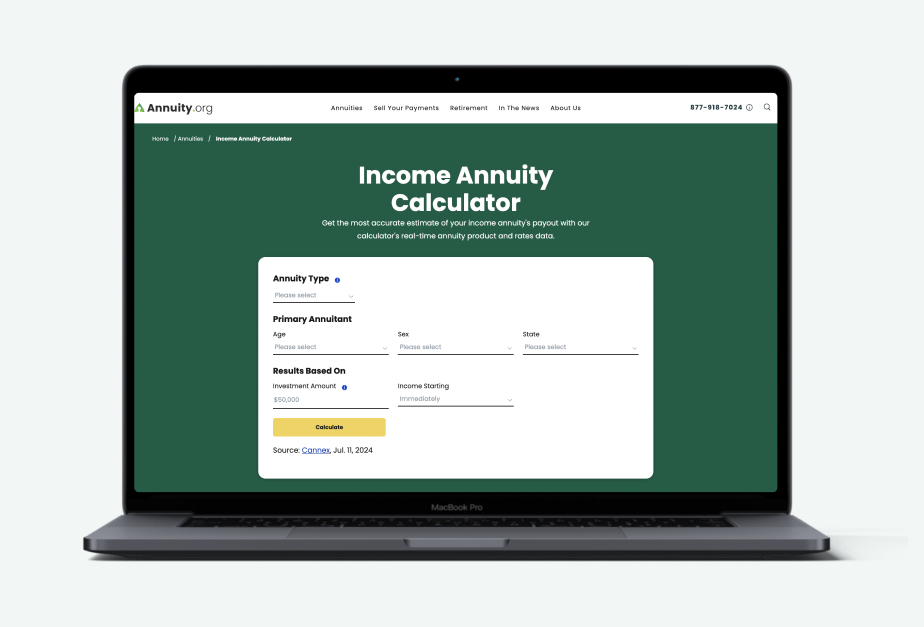
Convert $50,000 into an immediate annuity and the insurer commits to paying you a fixed monthly check for the rest of your life. Today, that check generally lands somewhere between $259 and $503, and three variables decide where in that range you fall: when you start drawing income, your gender and the payout structure you choose.
Waiting longer to begin lifts every dollar in the row below, since the insurer is now expected to write fewer total checks. Adding a spouse to the contract pulls the figures down. The same $50,000 has to support two lives instead of one, so each individual payment shrinks.
Each payment blends interest earnings with a portion of your premium coming back to you. That structure is what gives annuity income its stability, regardless of what stocks, bonds or interest rates do in any given year. The tables below map out what $50,000 produces across the most common buying ages and payout types, so you can pinpoint the row that lines up with your circumstances.
$50,000 Annuity Monthly Payout by Age and Type (September 2026 Rates)
A higher starting age boosts every figure across the row, because the insurer’s projected payment window grows shorter with each year you delay.
| Age | Gender | Single Life | Life + 10yr Certain | Life + 20yr Certain | Joint Life (same age) | Period Certain (20 yrs) |
| 60 | Male | $291 | $284 | $275 | $259 | $326 |
| 60 | Female | $279 | $278 | $270 | $259 | $326 |
| 65 | Male | $317 | $309 | $294 | $280 | $326 |
| 65 | Female | $305 | $300 | $288 | $280 | $326 |
| 70 | Male | $354 | $341 | $308 | $298 | $326 |
| 70 | Female | $336 | $328 | $300 | $298 | $326 |
| 75 | Male | $414 | $388 | $318 | $338 | $326 |
| 75 | Female | $392 | $369 | $314 | $338 | $326 |
| 80 | Male | $503 | $432 | $323 | $392 | $326 |
| 80 | Female | $465 | $418 | $320 | $392 | $326 |
How to interpret these numbers:
- Single life is the bare-bones contract: payments arrive each month for as long as you live, and stop the day you die, with nothing remaining for heirs.
- Life + 10 or 20 year certain blends a lifetime income stream with a guaranteed minimum window. You collect for life, but if you die before the certain term ends, the leftover scheduled payments pass to a beneficiary.
- Joint life ties the contract to two lives. Income runs until both spouses have passed, but the monthly figure is smaller, since the insurer is now planning around two life expectancies.
- Period certain hands the schedule to the calendar instead of the lifespan. Payments arrive for a defined number of years and then end, regardless of whether you’re still around. It tends to fit a specific phase of retirement rather than the whole stretch.
- Men’s monthly checks edge above women’s at the same age, because actuarial tables forecast a shorter retirement for men on average.
- Buying older lifts every column in the row, because the insurer expects fewer years of payments to spread the same $50,000 across.

A S F E A T U R E D I N
Featured in CBS News’ coverage of $50,000 annuity monthly income, citing Annuity.org’s analysis of Cannex data.
$50,000 Annuity Annual Payout Rates by Age and Type (September 2026 Rates)
These percentages express what $50,000 produces in annual income relative to your premium. They mix interest with a return of your principal, so they aren’t directly comparable to the yield on a stock or a bond.
| Age | Gender | Single Life | Life + 10yr Certain | Life + 20yr Certain | Joint Life (both same age) | Period Certain (20 yrs) |
| 60 | Male | 6.98% | 6.83% | 6.60% | 6.22% | 7.81% |
| 60 | Female | 6.71% | 6.66% | 6.47% | 6.22% | 7.81% |
| 65 | Male | 7.62% | 7.42% | 7.06% | 6.72% | 7.81% |
| 65 | Female | 7.33% | 7.21% | 6.91% | 6.72% | 7.81% |
| 70 | Male | 8.49% | 8.18% | 7.39% | 7.15% | 7.81% |
| 70 | Female | 8.05% | 7.88% | 7.19% | 7.15% | 7.81% |
| 75 | Male | 9.92% | 9.30% | 7.63% | 8.11% | 7.81% |
| 75 | Female | 9.40% | 8.87% | 7.55% | 8.11% | 7.81% |
| 80 | Male | 12.06% | 10.36% | 7.75% | 9.41% | 7.81% |
| 80 | Female | 11.15% | 10.04% | 7.68% | 9.41% | 7.81% |
Most importantly:
- Every year you delay starting income lifts the annual payout rate.
- Joint life trims the rate, because the same income now has to stretch across two lifespans.
- The payout rate resembles an interest rate, but it isn’t. It’s the share of your $50,000 returning to you as income each year.
What a $50,000 Annuity Looks Like in Practice
To see how different factors can affect the income from a $50,000 annuity, we’ve created three hypothetical examples. Each scenario features a different customer profile, showing how age, gender, and payout type influence the amount of guaranteed income you could receive from the same investment.
These estimates are based on data from Cannex and online annuity calculators, and are designed to give you a realistic sense of how payouts might look in real life — not exact quotes.
Meet Chris — Planning for a Steady Retirement Income Stream

Name: Chris
Age: 65
Looking to Invest: $50,000
- Chris wants a guaranteed income stream for life
- He purchases an immediate annuity with a lifetime payment
Monthly Payout: $313
Chris has recently retired and is looking to add another source of predictable income to supplement his Social Security and other retirement savings. While he’s already receiving benefits, Chris wants to ensure he has enough to comfortably cover his expenses every month without worrying about market ups and downs.
To achieve this, Chris invests $50,000 into an immediate annuity. This converts his savings into monthly payments of $313, starting shortly after his contract is issued.
Why He Chose a Lifetime Income Annuity
Chris selects a single-life policy, which continues payments until his death. The policy has no death benefit, meaning if Chris passes away before receiving the full value of his annuity premium, his beneficiaries will not receive the remaining balance. For Chris, maximizing his monthly payout while he’s alive is more important than leaving a financial legacy.
Knowing that his income is guaranteed for life gives Chris the peace of mind to enjoy retirement without the fear of running out of money.
Why This Works for Chris:
- The payout doesn’t fluctuate with the stock market.
- He knows the income will continue for life — no matter how long he lives.
- It supplements his Social Security benefits and other retirement income.
- It allows him to budget confidently, knowing his essentials will always be covered.
Bottom Line: Chris’s estimated monthly income from the annuity is $313, guaranteed for life. While the contract won’t pass value to his heirs if he dies early, the security of reliable monthly income is worth it for his retirement peace of mind.
Estimate Your Fixed Annuity Rate
Enter your email to unlock your estimated rate
Estimated Fixed Annuity Rate:
6.00%
Meet Eva — Planning for a Lifetime of Guaranteed Income

Name: Eva
Age: 60
Looking to Invest: $50,000
- Eva wants a guaranteed income stream for life
- She purchases an immediate annuity with a lifetime payment
Monthly Payout: $252
Eva is preparing to retire and wants the peace of mind that comes from knowing she’ll receive guaranteed income for the rest of her life. To achieve this, she invests $50,000 into an immediate lifetime annuity, which begins paying her $252 per month — starting shortly after the contract is issued.
Her payout is lower than Chris’s, even though they invested the same amount, for two main reasons: she is starting payments at age 60 (younger retirees receive smaller monthly payments because the payments are expected to last longer), and she is female (women typically receive slightly lower payments than men because they tend to live longer).
Why She Chose a Lifetime Income Annuity
Eva selects the single-life option, which provides income for as long as she lives but stops when she passes away. This means there is no death benefit — if she dies before receiving the full value of her premium, her beneficiaries will not receive the remaining amount.
For Eva, the priority is maximizing steady income during her lifetime so she can confidently cover her living expenses without worrying about market swings or outliving her savings.
Why This Works for Eva:
- The payout doesn’t fluctuate with the stock market.
- She knows the income will last for life — no matter how long she lives.
- It supplements her Social Security and helps cover her monthly expenses.
- It allows her to enjoy retirement without second-guessing every purchase.
Bottom Line: Eva’s estimated monthly income from the annuity is $252 — guaranteed for life. While it won’t pass to heirs, the security of knowing her essential expenses will always be covered makes this the right choice for her retirement plan.
Typically, with income annuities, retirees will put more than $50,000 into an annuity. However, if you are looking to supplement your income or cover a smaller monthly recurring bill, then a $50,000 annuity may be a good option. When people are looking to retire, they will reach out to me, and we will go through an income needs analysis, including inflation, to determine exactly how much funding is needed for the required income.
John Stevenson, CFFOwner and Advisor at Stevenson Retirement SolutionsJohn Stevenson, a Certified Financial Fiduciary®️, specializes in securing retirements with tax-free accounts. With a focus on guaranteed retirement, he’s ensured none of his clients suffer from market fluctuations. As a renowned educator and podcast host, John empowers thousands weekly, sharing his expertise in minimizing taxes and protecting against financial downturns.

Meet Steve — Growing His Retirement Savings Before Taking Income

Name: Steve
Age: 62
Looking to Invest: $50,000
- Steve wants to grow his savings before turning them into income
- He purchases a 3-year fixed annuity with a 6% interest rate
Monthly Payout: $313
Steve’s situation is different from Frank, Chris, and Eva because he isn’t ready to start receiving annuity payments yet. With a few years left before retirement, Steve wants to grow his savings first. He invests $50,000 in a multi-year guaranteed annuity (MYGA) that earns a fixed 6% interest rate for the length of the 3-year contract.
When the MYGA matures, Steve plans to convert the balance into lifetime income. By that time, his initial investment will have grown to $59,551, giving him a higher monthly payout than if he had purchased an immediate annuity today. Assuming payout rates remain the same, this could mean around $373 per month once he starts receiving income.
Why He Chose a Multi-Year Guaranteed Annuity
Steve chose a MYGA because it allows him to lock in a competitive interest rate and grow his money without market risk. Since he doesn’t need income right away, this strategy helps him maximize future payments when he does transition to retirement.
Once the contract ends, he can choose to convert the accumulated value into lifetime payments, ensuring predictable income later while benefiting from the growth in the meantime.
Why This Works for Steve:
- He earns a guaranteed 6% interest rate without stock market risk.
- His savings will grow before converting to income, resulting in a higher payout.
- He can time his annuity start date to match his retirement plans.
- He locks in a predictable growth rate for three years.
Bottom Line: Steve’s $50,000 investment will grow to $59,551 over three years at a 6% interest rate. When converted to income, his monthly payout will be higher than if he had started payments immediately, making this a smart choice for someone still a few years away from retirement.
Today’s Best Fixed Annuity Rates by Term
| Term | Rate | Provider | Product | AM Best Rating |
|---|---|---|---|---|
| 1 Year | 6.00% | Global Atlantic | ForeCare Fixed Annuity (LTC) | A |
| 2 Years | 5.25% | Mountain Life Insurance Company | Secure Summit | B- |
| 3 Years | 6.30% | Canvas Annuity | Canvas Future Fund | B++ |
| 4 Years | 6.05% | Mountain Life Insurance Company | Alpine Horizon | B- |
| 5 Years | 6.45% | Mountain Life Insurance Company | Alpine Horizon | B- |
| 6 Years | 6.35% | Oxford Life Insurance Company | Multi Select | A |
| 7 Years | 6.45% | Liberty Bankers Life | Heritage Premier Plus | A- |
| 8 Years | 6.45% | Oxford Life Insurance Company | Multi Select | A |
| 9 Years | 6.50% | Liberty Bankers Life | Heritage Premier Plus | A- |
| 10 Years | 6.50% | Canvas Annuity | Canvas Future Fund 10 Year | B++ |

Now See What Your Savings Could Pay You
Factors Impacting How Much a $50,000 Annuity Pays Per Month
Annuity providers calculate payouts differently for every annuity contract. An annuity with a $50,000 premium can have widely varying monthly payments depending on several factors.
- Annuitant’s age: Insurers use the annuitant’s life expectancy to calculate annuity payouts. The longer you’re expected to live, the more payments the insurer expects to pay out, so your payments will be shorter.
- Annuitant’s gender: Women tend to live longer than men, so a 75-year-old woman will receive slightly smaller annuity payments than a 75-year-old man.
- Type of annuity: The type of annuity can impact the annuity’s value at annuitization, which is used to calculate the payout amount. A $50,000 deferred annuity that earns interest will produce higher payouts than a $50,000 immediate annuity that starts paying out right away.
- Payout period: As previously stated, the longer you’re expected to receive payments, the smaller the payment amount will be. A 10-year period certain annuity will likely have a higher payout than a lifetime annuity. A $50,000 joint and survivor annuity that covers two lifetimes will have a lower payout than a single life annuity of the same amount.
- Riders: You can customize your annuity with riders and provisions, but these may affect your payout amount. For example, a return of premium rider or death benefit represents a greater level of risk to the insurer, so your payout amount will likely be slightly lower each month if you opt for these features.