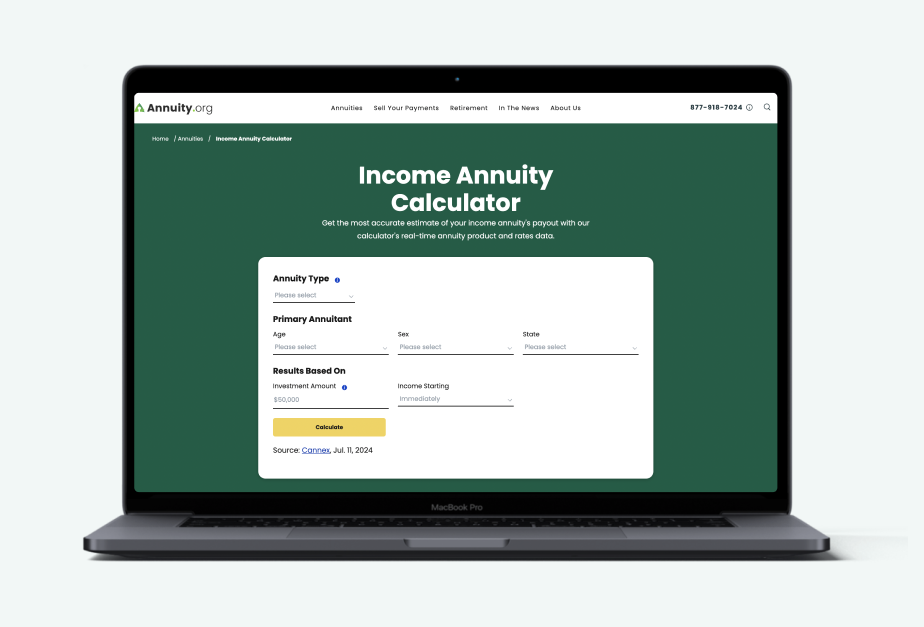
A $500,000 immediate annuity pays about $3,053 a month for life to a 65-year-old woman, with most payouts ranging from $2,619 to $5,039.
Where you land depends on your age when payments start, your gender and the payout type you choose. Starting later raises the monthly amount because the insurer expects fewer payments, while adding a spouse lowers it because the same money has to cover two lives.
Each check combines interest and a return of your principal, so it stays the same no matter what the markets do. Find your age and payout type in the table below.
$500,000 Annuity Monthly Payout by Age and Type
Starting older lifts every dollar figure in the row, because the insurer’s expected payout window is shorter.
| Age | Gender | Single Life | Life + 10yr Certain | Life + 20yr Certain | Joint Life (same age) | Period Certain (20 yrs) |
| 60 | Male | $2,925 | $2,896 | $2,749 | $2,619 | $3,268 |
| 60 | Female | $2,808 | $2,777 | $2,731 | $2,619 | $3,268 |
| 65 | Male | $3,184 | $3,128 | $2,946 | $2,800 | $3,268 |
| 65 | Female | $3,053 | $3,008 | $2,889 | $2,800 | $3,268 |
| 70 | Male | $3,551 | $3,414 | $3,086 | $3,003 | $3,268 |
| 70 | Female | $3,374 | $3,280 | $3,025 | $3,003 | $3,268 |
| 75 | Male | $4,162 | $3,878 | $3,212 | $3,377 | $3,268 |
| 75 | Female | $3,916 | $3,695 | $3,180 | $3,377 | $3,268 |
| 80 | Male | $5,039 | $4,353 | $3,247 | $3,923 | $3,268 |
| 80 | Female | $4,678 | $4,183 | $3,231 | $3,923 | $3,268 |
How To Read These Numbers
- Single life: pays for as long as you live.
- Life + 10 or 20 years certain: pays for life, and if you die within the guarantee period, your beneficiary gets the remaining payments.
- Joint life: pays as long as either spouse is living.
- Period certain: pays for a set number of years, then stops. It’s useful for bridging a gap, like the years before Social Security or a pension starts.

A S F E A T U R E D I N
Featured in CBS News’ coverage of $500,000 annuity monthly income, citing Annuity.org’s analysis of Cannex data.
Real-World Examples: Ted, Ella & Irene
Here’s how age, gender and payout choice change what the same $500,000 pays.
| Ted | Ella | Irene | You | |
| Age | 75 | 65 | 65 | Your age |
| Payout option | Life only | Life only | Life + 20-year certain | Your choice |
| Monthly income | $4,162 | $3,053 | $2,889 | See your number → |
| Yearly income | $49,944 | $36,636 | $34,668 | Based on your answers |
| Priority | The most income while active in retirement | Guaranteed income she can’t outlive | Lifetime income, plus payments to her beneficiary if she dies early | What matters most to you |
What the Examples Show
- Age raises the payout. At 75, Ted gets about $1,109 more a month than Ella at 65. Even a 75-year-old woman would get $3,916, about $863 more than Ella, because the insurer expects to make payments for fewer years.
- Gender matters. Women generally live longer, so a 75-year-old woman choosing life only would get about $246 a month less than Ted.
- Life only pays the most, with a trade-off. Ella’s $3,053 a month is guaranteed for life. If she dies before collecting the full $500,000, the remaining balance stays with the insurer.
- A guarantee period protects heirs. Irene’s 20-year certain option pays $164 a month less than Ella’s life-only annuity, but it guarantees at least $693,360 in total payments to her or her beneficiary.
$500,000 Annuity Annual Payout Rates by Age and Type
These percentages are what $500,000 pays out per year, combining interest with the gradual return of your principal. They aren’t a yield comparable to a bond or stock.
| Age | Gender | Single Life | Life + 10yr Certain | Life + 20yr Certain | Joint Life (both same age) | Period Certain (20 yrs) |
| 60 | Male | 7.02% | 6.95% | 6.60% | 6.29% | 7.84% |
| 60 | Female | 6.74% | 6.66% | 6.55% | 6.29% | 7.84% |
| 65 | Male | 7.64% | 7.51% | 7.07% | 6.72% | 7.84% |
| 65 | Female | 7.33% | 7.22% | 6.93% | 6.72% | 7.84% |
| 70 | Male | 8.52% | 8.19% | 7.41% | 7.21% | 7.84% |
| 70 | Female | 8.10% | 7.87% | 7.26% | 7.21% | 7.84% |
| 75 | Male | 9.99% | 9.31% | 7.71% | 8.11% | 7.84% |
| 75 | Female | 9.40% | 8.87% | 7.63% | 8.11% | 7.84% |
| 80 | Male | 12.09% | 10.45% | 7.79% | 9.42% | 7.84% |
| 80 | Female | 11.23% | 10.04% | 7.76% | 9.42% | 7.84% |
Most importantly:
- Annual payout rates rise the longer you wait to begin.
- Adding a spouse trims the rate, because the income now has to support two lifetimes instead of one.
- A payout rate isn’t a yield or an interest rate. It’s the percentage of your $500,000 sent back to you as income each year.
Income annuities are popular for providing predictable retirement income. Payment calculations depend on factors like gender, age, time frame, and the product vehicle. For example, a $500K annuity provides $2,997 per month to a 65-year-old woman. Older individuals and married couples receive more or less based on life expectancy and shared income. Annuities offer a safe way to secure predictable income in retirement.
Aamir M. Chalisa, MBA, LUTCF, MDRTGeneral Manager at Futurity First Insurance GroupAamir M. Chalisa is a seasoned financial services leader with over 30 years of experience in insurance, wealth management and retirement planning. As General Manager of Futurity First Insurance Group’s Oak Brook branch, he oversees one of the company’s top-performing teams. Aamir has held leadership roles at MetLife, Prudential and Nationwide and is a Million Dollar Round Table (MDRT) qualifier, recognized for his expertise in life and annuity sales and commitment to helping clients achieve lasting financial security.


Now See What Your Savings Could Pay You
Factors Impacting How Much a $500,000 Annuity Pays Per Month
Annuity providers calculate payouts differently for every annuity contract. An annuity with a $500,000 premium can have widely varying monthly payments depending on several factors.
- Annuitant’s age: Life expectancy factors into annuity payout calculations because the more years you live after you start receiving payments, the more payments you’ll receive. This means younger people tend to have lower payouts.
- Annuitant’s gender: On a similar note, women tend to have a higher life expectancy than men, so a woman’s annuity payout will be lower than a man of the same age.
- Payout period: You can choose an annuity that pays out for a certain number of years, for life, or even your and your spouse’s lives. The longer you’re expected to receive payments, the smaller the payment amount will be. A $500,000 straight life annuity will have a higher payout than a life with period certain or a joint and survivor annuity of the same premium amount.
- Type of annuity: Immediate annuities are the easiest payments to calculate because they begin paying out right away. If you purchase a $500,000 deferred annuity with an interest rate, the value the annuity accumulates before it converts to income will factor into how much you’ll receive when the contract pays out.
- Riders: Annuity owners can customize their contracts with riders and provisions, like a death benefit or return of premium rider. However, these add-ons often come at a cost and can result in a lower monthly payment.
The same $500,000 can pay a 60-year-old woman $2,808 a month and an 80-year-old man $5,039, which is why two people with the same premium can see very different checks.
Frequently Asked Questions
A $500,000 immediate annuity pays about $3,053 a month for a 65-year-old woman and $3,184 for a 65-year-old man, choosing life only. Depending on age, gender and payout option, most payouts fall between $2,619 and $5,039 a month, based on September 2026 quotes.
Yes. A man who buys a $500,000 life-only annuity at 60 gets about $2,925 a month, compared with $3,551 at 70 and $5,039 at 80. Insurers pay more to older buyers because they expect to make payments for fewer years.
With a life-only annuity, payments stop at death, and any remaining balance stays with the insurer. A guarantee option such as life + 10 years certain pays your beneficiary the remaining payments if you die early, in exchange for a slightly lower check: $3,008 a month instead of $3,053 for a 65-year-old woman.
A $500,000 joint annuity for a couple who are both 65 pays about $2,800 a month for as long as either spouse is living. That’s less than a single-life annuity, because the payments may have to cover two lifetimes.
The monthly payout is the dollar amount you receive. The payout rate is your yearly payments divided by your premium: 7.64% for a 65-year-old man buying a $500,000 annuity. It isn’t an interest rate, because each payment includes a return of your own principal.
They’re estimates based on immediate annuity quotes for a $500,000 non-qualified premium in Florida as of September 2026. Your actual payout depends on the insurer, your state and rates when you buy. Once you buy, the contract locks in your payment.
Still have questions?