At today’s rates, a $400,000 immediate annuity converts into roughly $2,095 to $4,031 of guaranteed monthly income for life. Where you fall on that range depends on three inputs: your age at purchase, your gender and the payout option you select.
Each year you postpone the start date, the monthly amount climbs, since the insurer’s expected payout horizon gets shorter. Folding a spouse onto the contract works in reverse. The same $400,000 now has to support two people instead of one, so the monthly check shrinks accordingly.
Behind the scenes, every check you cash is part interest and part principal working its way back to you. That mix is what makes annuity income immune to market swings. Use the tables below to see what $400,000 produces at five common ages and across the most popular payout types, then find the row that matches your plan.
$400,000 Annuity Monthly Payout by Age and Type (September 2026 Rates)
Every five-year delay in your start age produces a noticeably larger check, because the insurer plans on paying for fewer total years.
| Age | Gender | Single Life | Life + 10yr Certain | Life + 20yr Certain | Joint Life (same age) | Period Certain (20 yrs) |
| 60 | Male | $2,340 | $2,315 | $2,199 | $2,095 | $2,614 |
| 60 | Female | $2,245 | $2,221 | $2,185 | $2,095 | $2,614 |
| 65 | Male | $2,547 | $2,502 | $2,357 | $2,240 | $2,614 |
| 65 | Female | $2,442 | $2,406 | $2,311 | $2,240 | $2,614 |
| 70 | Male | $2,840 | $2,731 | $2,469 | $2,403 | $2,614 |
| 70 | Female | $2,699 | $2,624 | $2,420 | $2,403 | $2,614 |
| 75 | Male | $3,330 | $3,102 | $2,570 | $2,702 | $2,614 |
| 75 | Female | $3,133 | $2,956 | $2,544 | $2,702 | $2,614 |
| 80 | Male | $4,031 | $3,482 | $2,597 | $3,139 | $2,614 |
| 80 | Female | $3,742 | $3,346 | $2,585 | $3,139 | $2,614 |
How to interpret these numbers:
- Single life provides income from purchase day until your death, with no payments to anyone after.
- Life + 10 or 20 year certain attaches a guarantee period to a lifetime payout. Die before the guarantee window runs out and your beneficiary receives whatever payments remain on the schedule.
- Joint life keeps the income flowing for both spouses, ending only after the second one passes. The trade-off is a noticeably smaller monthly figure.
- Period certain is the only option here that isn’t tied to your lifespan. It pays a fixed amount for a set window of years and then ends, which makes it the right pick for plugging a known income gap, such as the years between early retirement and the day Social Security or a pension activates.
- Men collect somewhat larger checks at every age, because actuaries expect men to live shorter lives than women.
- Each step up in starting age boosts every figure in the row, since the insurer’s expected payment window narrows.

A S F E A T U R E D I N
Featured in CBS News’ coverage of $400,000 annuity monthly income, citing Annuity.org’s analysis of Cannex data.
Get Your Personalized $400,000 Annuity Quote
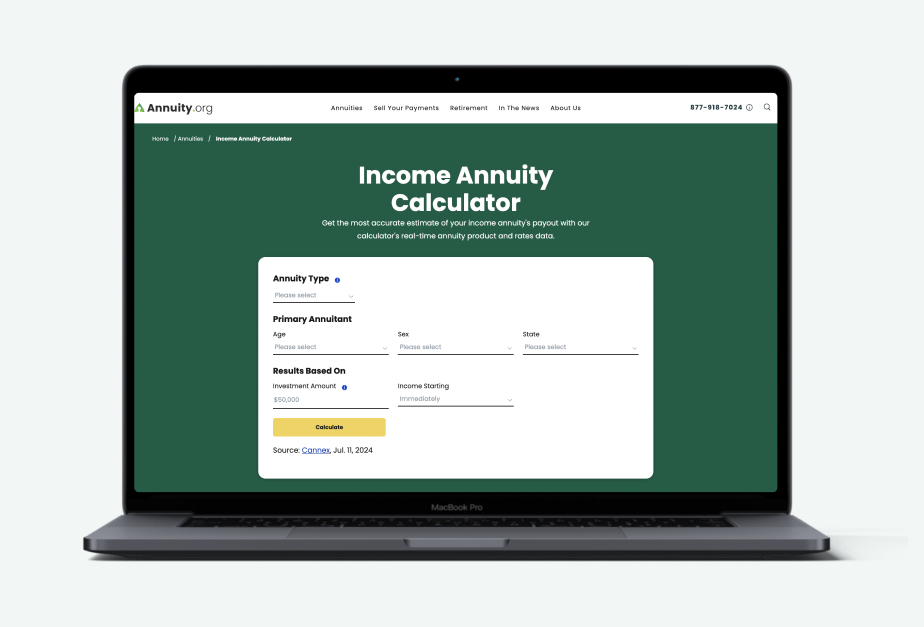
The figures above are estimates. Your actual payout depends on your age, gender, state of residence, and the specific carrier you choose. Use our free annuity calculator to see what $400,000 could pay you.
Use the Annuity Calculator →
$400,000 Annuity Annual Payout Rates by Age and Type (September 2026 Rates)
Each row tells you how much annual income $400,000 generates, expressed as a percentage of your premium. It’s a blend of interest and the principal you’re getting back, not a yield in the way a bond or stock yield is calculated.
| Age | Gender | Single Life | Life + 10yr Certain | Life + 20yr Certain | Joint Life (both same age) | Period Certain (20 yrs) |
| 60 | Male | 7.02% | 6.95% | 6.60% | 6.28% | 7.84% |
| 60 | Female | 6.74% | 6.66% | 6.55% | 6.28% | 7.84% |
| 65 | Male | 7.64% | 7.51% | 7.07% | 6.72% | 7.84% |
| 65 | Female | 7.33% | 7.22% | 6.93% | 6.72% | 7.84% |
| 70 | Male | 8.52% | 8.19% | 7.41% | 7.21% | 7.84% |
| 70 | Female | 8.10% | 7.87% | 7.26% | 7.21% | 7.84% |
| 75 | Male | 9.99% | 9.31% | 7.71% | 8.11% | 7.84% |
| 75 | Female | 9.40% | 8.87% | 7.63% | 8.11% | 7.84% |
| 80 | Male | 12.09% | 10.45% | 7.79% | 9.42% | 7.84% |
| 80 | Female | 11.23% | 10.04% | 7.76% | 9.42% | 7.84% |
Most importantly:
- Older starting ages bring higher annual payout rates, every time.
- Joint life cuts the rate, since the same income now has to underwrite two lifetimes.
- Don’t read the payout rate as an interest rate. It’s the slice of your $400,000 you receive back each year as income.
Real Scenarios: What a $400,000 Annuity Can Do for You
A $400,000 annuity can serve as the foundation for a dependable retirement income strategy — whether you’re looking to fill a gap between Social Security and spending needs, provide long-term security for a spouse, or reduce market exposure.
At this investment level, monthly income becomes even more substantial — enough to consistently cover key expenses like housing, healthcare, or travel. But how much you actually receive depends on your age, the payout structure you choose, and how long you need income to last.
The examples below show how retirees with different goals and timelines use $400,000 annuities to create income they can rely on — for life.
Diego — Planning a Safe, Guaranteed Income for Retirement

Name: Diego
Age: 55
Income Start Age: 65
Investment Amount: $400,000
- Wants to lock in future income now for retirement
- Looking to reduce market exposure in the final decade of work
- Wants to protect his heirs in case of early death
| Payout Option | Life with 20 year certain |
| Monthly Income | $2,292 |
| Payout Percentage | 6.88% |
| Minimum Payout | $549,480 |
At 55, Diego is ten years away from retirement — and he’s focused on predictability. Rather than leaving his income to chance, he invests $400,000 into a deferred income annuity that begins paying out when he turns 65. This strategy allows him to secure future income while avoiding market risk during his final working years.
Why He Added a 20-Year Guarantee:
Diego selects a life with 20-year certain payout, which guarantees that his annuity will pay out for at least 20 years — even if he passes away early. This means his heirs will receive the remaining payments if he doesn’t live into his late 80s.
At age 65, Diego is guaranteed a monthly income of $2,292, totaling at least $549,480 over the first 20 years — and more if he lives longer.
Bottom Line: By planning ahead, Diego creates a guaranteed retirement paycheck that begins exactly when he needs it. With the added security of a 20-year guarantee, this strategy gives him the clarity and confidence to retire on his terms.
Estimate Your Fixed Annuity Rate
Enter your email to unlock your estimated rate
Estimated Fixed Annuity Rate:
6.00%
Carol — Prioritizing High Payouts and Simplicity in Retirement

Name: Carol
Age: 65
Income Start Age: 65
Investment Amount: $400,000
- Wants to maximize income immediately in early retirement
- Prefers an easy, hands-off approach to money management
- Prioritizes guaranteed payouts and legacy planning
| Payout Option | 20 year period certain only |
| Monthly Income | $1,784 |
| Payout Percentage | 5.35% |
| Minimum Payout | $428,160 |
Carol is ready to retire now and wants to use her $400,000 to create guaranteed, high-impact income over the next 20 years — a time she plans to spend traveling and enjoying life with family. She’s not interested in managing investments during retirement, and she’s already made separate arrangements (like life insurance) to leave a legacy.
Why She Chose a 20-Year Period Certain Annuity:
Carol selects a 20-year period certain payout, which guarantees fixed monthly payments for exactly 20 years — no matter what happens to her health. This allows her to receive $4,077/month, or more than $428,000 total, with no concern about market swings or early death cutting off income.
If she passes away during the term, her beneficiaries will receive the remaining payments — ensuring her full investment is protected.
What This Strategy Gives Her:
- Maximum short-term income during her most active retirement years
- Complete freedom from managing accounts or taking withdrawals
- Peace of mind knowing her family will receive remaining payments if needed
Bottom Line: For retirees focused on maximizing income in a fixed time frame, a period certain annuity offers simplicity, predictability, and value — especially when other legacy tools are already in place.
Scenario 3

- Names: Robert & Leslie
- Ages: 70
- Payout Option: Joint Life with 10-Year Certain
- Goal #1: Create a stream of income to support them in their old age that won’t expire
- Goal #2: Provide a potential legacy for their child Amy
| Payout Option | Joint Life with 10 year certain |
| Monthly Income | $3,324 |
| Payout Percentage | 9.97% |
| Minimum Payout | $398,880 |
Robert and Leslie want a dependable source of income that will begin when they turn 80, ensuring financial stability in their later years. To protect against the possibility of outliving their savings, they choose a joint life annuity with a 10-year payment guarantee.
With this option, they’ll receive $3,324 per month, income that continues as long as either of them is alive. If one spouse passes away, the other will keep receiving the full payment. And if they both pass away before the 10-year guarantee is met, their daughter Amy will inherit the remaining payments. This approach gives them peace of mind that their income will last, while also preserving a potential legacy for their family.
Today’s Best Fixed Annuity Rates by Term
| Term | Rate | Provider | Product | AM Best Rating |
|---|---|---|---|---|
| 1 Year | 6.00% | Global Atlantic | ForeCare Fixed Annuity (LTC) | A |
| 2 Years | 5.25% | Mountain Life Insurance Company | Secure Summit | B- |
| 3 Years | 6.30% | Canvas Annuity | Canvas Future Fund | B++ |
| 4 Years | 6.05% | Mountain Life Insurance Company | Alpine Horizon | B- |
| 5 Years | 6.55% | Knighthead Life | Staysail | A- |
| 6 Years | 6.35% | Oxford Life Insurance Company | Multi Select | A |
| 7 Years | 6.95% | Knighthead Life | Staysail | A- |
| 8 Years | 6.45% | Oxford Life Insurance Company | Multi Select | A |
| 9 Years | 6.50% | Liberty Bankers Life | Heritage Premier Plus | A- |
| 10 Years | 6.50% | Canvas Annuity | Canvas Future Fund 10 Year | B++ |

Now See What Your Savings Could Pay You
Tax Treatment of $400,000 Annuity Income
How your annuity income is taxed depends on whether you funded it with pre-tax or after-tax dollars.
Qualified Annuity (funded with pre-tax money, such as an IRA or 401(k) rollover): Every dollar of your monthly payment is taxed as ordinary income. If your $400,000 annuity pays $2,590 per month ($31,080 per year), the full $31,080 is added to your taxable income for the year.
Nonqualified Annuity (funded with after-tax money): Only the earnings portion of each payment is taxed, thanks to the exclusion ratio. If you paid $400,000 for an annuity expected to pay over 20 years, roughly $20,000 per year is considered return of principal (not taxed), and the remainder is taxable income. This can make annuity income significantly more tax-efficient than a qualified distribution.
Early Withdrawal Penalty: Withdrawals before age 59 ½ incur a 10% IRS penalty on top of ordinary income tax. Surrender charges from the insurance company may also apply during the first 5–7 years of the contract.
Factors Impacting How Much a $400,000 Annuity Pays per Month
The payouts offered by annuity companies will be calculated based on several factors in each individual annuity contract. The individual quote you receive on your $400,000 income annuity may differ based on one or all of the following information. It is important to explore many products from various companies to find the type of contract that will meet your needs.
- Owner’s Age: The older the owner of the annuity contract is, the greater the payment will be. Life expectancy is one of the most important factors in determining an annuity’s payout.
- Owner’s Gender: Women have, on average, a longer life expectancy than men. Therefore, their payouts are smaller than those for men of a similar age.
- Type of Annuity: An immediate income annuity will have a smaller payout compared to a deferred income annuity, which will begin payouts later.
- Expected Payout Period: An older individual will have a shorter payout period (life expectancy) than a younger person. Guaranteed payout periods, such as a 10-year period certain will translate into a lower payment than a life-only income annuity. Similarly, a joint annuity will be expected to have a longer payout period than a single-life annuity.
- Optional Riders: Riders such as return of premium, period certain or a guaranteed death benefit will reduce the payout amount compared to a life-only annuity.
- Market Environment: The prevailing interest rate environment can impact payout rates for annuities. Lower interest rates, especially over a long period of time, mean insurance companies expect to earn less on their investments. Therefore, insurers must pay less relative to periods of time with higher interest rates.
Frequently Asked Questions
Yes. A $400,000 single-premium immediate annuity (SPIA) can pay well over $2,000 per month for most buyers aged 55 and older. At age 65, a male buyer can expect approximately $2,500 per month, well above the $2,000 threshold, though joint-life payouts at the same age may fall slightly below.
Age is the single biggest factor. A 60-year-old might receive approximately $2,120/month, while a 75-year-old could receive $3,680/month or more from the same $400,000 premium. This is because the insurance company expects to make payments over a shorter period for older buyers, so each monthly check is larger.
Splitting your $400,000 across multiple annuities (a strategy called annuity laddering) can reduce your exposure to interest rate risk. For example, you might put $200,000 into an immediate annuity for current income and $200,000 into a deferred annuity that starts paying in 5 years at a potentially higher rate.
Annuity payouts scale linearly with premium. If a $400,000 SPIA pays $2,500 per month at age 65, a $300,000 SPIA would pay approximately $1,875 per month, and a $500,000 SPIA would pay approximately $3,125 per month. The rate per dollar is the same regardless of investment size.
Still have questions?