What Factors Affect Annuity Payout Calculations?
Your monthly annuity income is calculated using formulas that account for your age and life expectancy, payout structure and current interest rates. Small adjustments to any of these variables can meaningfully change your payout.
Your Age and Timing
Because annuities are designed to provide income over your lifetime, insurers estimate how long payments may be made. The older you are when income begins, the higher your monthly payment typically will be. Delaying income can also increase future payouts because your premium has more time to grow and the expected payment period shortens.
Your Payout Structure
If you choose added protections — such as covering a spouse or guaranteeing payments for a minimum number of years — your income will be slightly lower than a single-life option. These guarantees provide added security for loved ones, but they require the insurer to plan for a longer potential payout period.
Interest Rates at the Time of Purchase
Interest rates directly affect how much income an insurer can offer. When rates are strong, monthly payments are generally higher. When rates are lower, payouts may decrease.
How Much Does a $100,000 Annuity Pay Per Month?
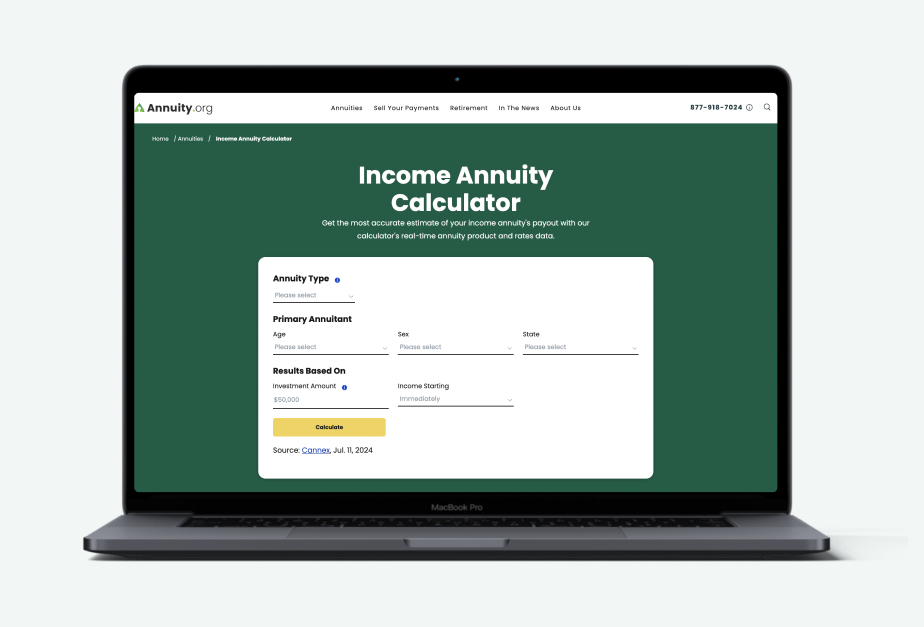
A $100,000 immediate annuity for a 65-year-old might pay approximately $600–$700 per month, depending on interest rates and payout option. Use the calculator above to generate personalized estimates.
Immediate vs. Deferred Income Annuities: What’s the Difference?
Immediate income annuities — also called Single Premium Immediate Annuities (SPIAs) — start paying income within the first year after purchase, often within 30 days. They’re designed for retirees who want to turn savings into income right away.
Deferred income annuities (DIAs) delay payments until a future date you choose — often five, ten, or even twenty years later. The longer your deferral period, the higher your eventual payout, because your money earns interest and the insurer assumes fewer total payout years.
In short:
- Choose an immediate annuity if you want guaranteed income starting now.
- Choose a deferred annuity if you want guaranteed income starting later (and potentially higher payments).
Our calculator lets you model both scenarios by adjusting the “Income Starting” field to “Immediately” or a future age or date.
PRUDENTIAL
Annuities are issued by The Prudential Insurance Company of America, Newark, NJ, and affiliates.
Start creating a more secure retirement
Whether it’s years away or just around the corner, Prudential offers protected income options that can help provide confidence throughout retirement.
- 150+ years in business
- Income, growth & protection solutions
- No obligation to buy
Annuity Payout Options
Your payout choice determines how long income lasts and whether beneficiaries are covered. There are three common structures.
- Period Certain (Fixed Term)
- Provides guaranteed payments for a set number of years, typically 10 to 25. Payments continue to a beneficiary if you pass away during the term but stop once the selected period ends — even if you are still living. Often used to cover temporary expenses or create a timed legacy.
- Single Life (Lifetime Income)
- Pays income for your lifetime only. Because it covers one life with no survivor benefit, this option generally offers the highest monthly payout. Best for those focused on maximizing personal retirement income.
- Joint Life (Spousal Protection)
- Provides lifetime income for two people, usually you and your spouse. Payments continue as long as either of you is alive. Monthly income is lower than single life, but it ensures ongoing financial support for a surviving spouse.
How Your Payout Option Affects Monthly Income
The payout option you choose determines both how much you receive each month and who continues receiving income after your death. Some options maximize your personal income, while others provide added protection for a spouse or beneficiary.
Here’s how monthly income from a $200,000 annuity may vary by payout structure:
| Option | Monthly Payment | What It Means | Best For |
|---|---|---|---|
| Life with 10-Year Period Certain | $1,218 | Pays for life. If you pass away within 10 years, remaining guaranteed payments go to your beneficiary (minimum $146,160). | Balancing income with legacy protection |
| Single Life | $1,234 | Highest monthly payout. Payments stop at death with no beneficiary benefits. | Maximizing personal income |
| Joint Life | $1,112 | Pays as long as either spouse is alive. No payments after both pass away. | Protecting a spouse |
Choosing a payout option isn’t just about maximizing income — it’s about balancing today’s payment amount with long-term financial security. Use the calculator to compare scenarios and find the structure that best fits your retirement goals.